Sensors & outputs Trigger
Crank / cam VR
Magnetic pickup, 2-wire reluctor · sensor · Trigger
Passive two-wire coil. Polarity matters. Crank lands on VR 1, cam on VR 2. A long-low then long-high pair on the composite log is inverted — swap the two wires.
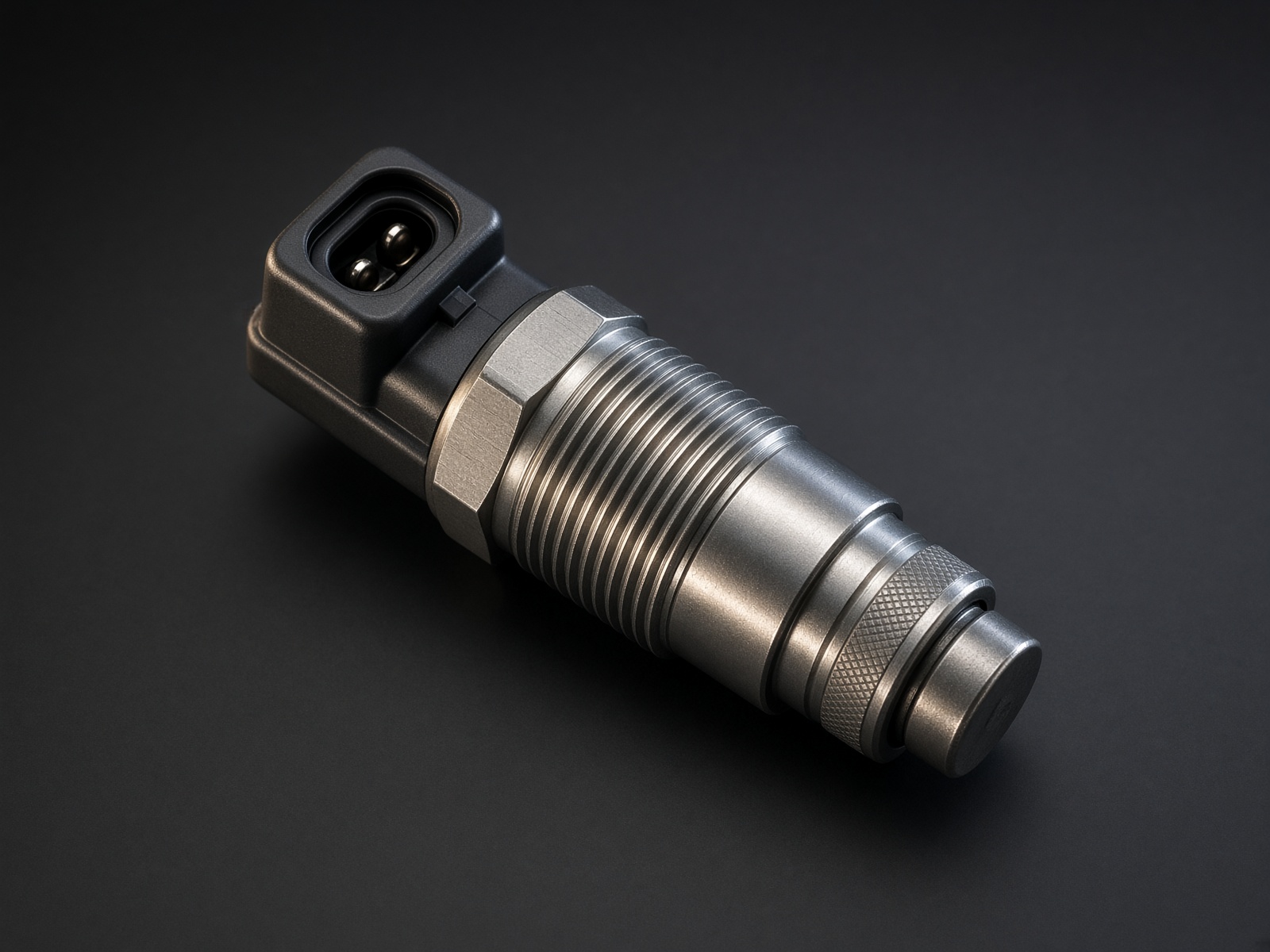
Typical parts: Honeywell / Cherry 1GT101DC-style VR; Ford 2-wire crank VR; BMW M50 crank VR
Warning — Polarity is the first test. Composite log: even teeth, one clean gap. A long-low then long-high missing-tooth pair means swap + / −. Offset cannot fix that.
Device pinout
Looking into the sensor. Marked + goes to VR n+; unmarked or − goes to VR n−.
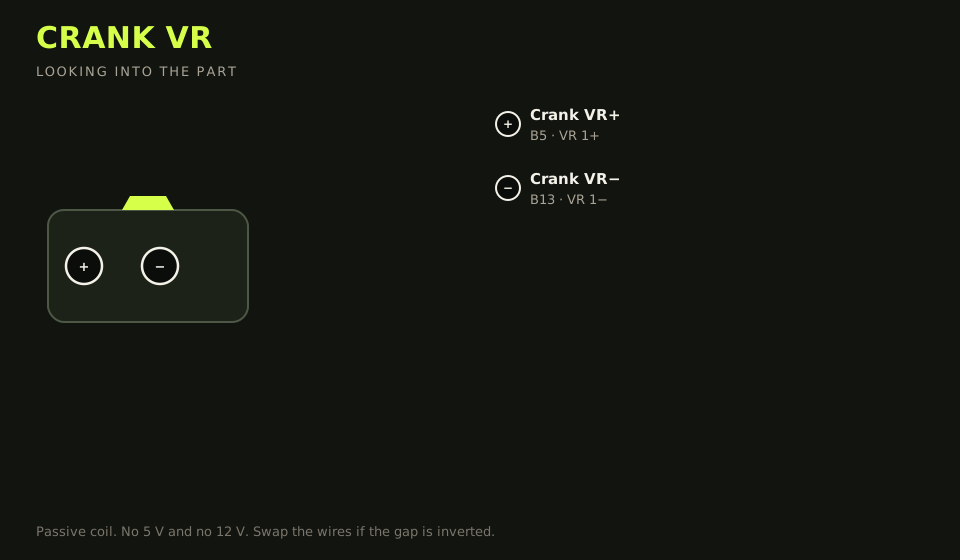
- Connector: 2-way on the sensor. No 5 V, no 12 V.
- Layout (looking into the part): + · −; polarising key top
| Device pin | Function | Type | Race Core | TunerStudio |
|---|---|---|---|---|
| + | Crank VR+ | Signal | B5 | VR 1+ |
| − | Crank VR− | Ground | B13 | VR 1− |
Wiring notes
- Cam VR uses the same two-wire sensor: + to B4 (VR 2+), − to B12 (VR 2−).
- Twisted pair. Shield to sensor ground at the ECU end only. Do not ground the shield at the engine.
- Air gap 0.5–1.0 mm on most wheels. Too far and cranking RPM is 0. Too close and the sensor eats teeth.
- A Hall sensor on a VR input will not decode. See Crank Hall.
- 36-1 and 60-2 are the default race wheels. Nissan 36-2-2-2 and Toyota 12-tooth are named decoders — not ‘a 36-1 with a funny gap’.
- A 36-1 disc in front of this sensor is the 36-1 trigger wheel. The 1.8T 60-2 inductive pickup is the Audi AUM crank note.
Failure modes
- Composite log shows a long low then a long high at the gap: polarity is inverted. Swap the two wires.
- Cranking rpm 0: air gap too large, or a Hall sensor was landed on VR 1.
- Cranking rpm in the thousands: both edges are being counted. Check the VR conditioner and the gap.
- Timing walks with rpm: the pair is running with the coil harness, or the shield is grounded at both ends.